
Modern business operations rely heavily on seamless digital infrastructure. As enterprise workflows shift to multi-cloud environments, real-time data analytics, hybrid work models, and bandwidth-intensive artificial intelligence applications, reliable connectivity is no longer a luxury. It is a fundamental operational necessity.
For enterprise decision-makers across Nigeria, standard shared broadband packages frequently fall short. Traffic congestion during peak hours, unpredictable latency, variable download speeds, and asymmetric upload capacities can derail mission-critical processes. This operational gap drives forward-thinking organizations toward Dedicated Internet Access (DIA).
Choosing between Dedicated Fiber Optics and Fixed Wireless (Radio) Access is a strategic decision that shapes an enterprise’s long-term digital agility. Both mediums deliver exclusive, unthrottled throughput, but their underlying architectures present distinct trade-offs in deployment speed, geographic availability, resilience, and total cost of ownership.
Understanding Dedicated Internet Access (DIA)
Dedicated Internet Access (DIA) provides an exclusive, unshared point-to-point connection between a customer’s local area network (LAN) and the Internet Service Provider (ISP) core network. Unlike shared residential or standard business broadband—where bandwidth is oversubscribed across dozens of nearby subscribers—DIA guarantees that your allocated throughput remains entirely yours 100% of the time.
Key Technical Attributes of DIA
- Symmetric Throughput (1:1 Allocation): Download and upload speeds are completely identical. An organization subscribed to a 100 Mbps DIA circuit receives 100 Mbps downstream and 100 Mbps upstream simultaneously. This balance is critical for cloud backups, VoIP telephony, enterprise video conferencing, and large file transmissions.
- Service Level Agreements (SLAs): Enterprise DIA contracts come backed by legally binding SLAs. These metrics guarantee network uptime (typically 99.9% or higher), define strict latency upper bounds, limit packet loss, and mandate guaranteed Mean Time to Repair (MTTR).
- Guaranteed Contention Ratio: Standard broadband operates on aggressive oversubscription rates (often 10:1 or 20:1). DIA enforces a strict 1:1 contention ratio, eliminating speed drops during high-traffic enterprise working hours.
Enterprise Fiber Optics: The High-Capacity Infrastructure Standard
Dedicated Fiber Optic Internet delivers data via modulated light pulses traveling through strands of high-purity glass cores. Because light experiences minimal signal degradation over vast distances, fiber represents the international benchmark for raw network capacity and stability.
For enterprise-grade installations, providers deploy Fiber to the Building (FTTB) or Fiber to the Premises (FTTP) using active optical Ethernet equipment rather than passive optical networks (PON). This structure preserves strict 1:1 dedicated performance.
Key Advantages of Enterprise Fiber
- Near-Infinite Scalability: A single physical fiber link supports bandwidth expansion from 10 Mbps up to 10 Gbps and beyond simply by upgrading the optical transceiver endpoints at the customer premises and provider edge.
- Immunity to Electromagnetic Interference (EMI): Fiber optics use light instead of electrical signals over copper. Consequently, fiber lines are immune to radio frequency interference, high-voltage power lines, weather-induced signal fading, and atmospheric electrical disruptions.
- Ultra-Low Latency: Fiber delivers minimal signal propagation delay. This low latency makes it the gold standard for latency-sensitive cloud workloads, real-time financial trading, and enterprise Resource Planning (ERP) syncs hosted on cloud platforms like Microsoft Azure or Amazon Web Services (AWS).
Strategic Implementation Challenges
- Civil Infrastructure & Deployment Lead Times: Physical trenching, ducting, and securing right-of-way permissions in dense commercial hubs (such as Victoria Island, Ikeja, or Abuja) can extend installation timelines from weeks to months.
- Physical Vulnerability: Optical cables laid underground or hoisted along utility poles remain vulnerable to accidental fiber cuts resulting from road construction, civil work, or localized physical disruptions.
Fixed Wireless (Radio) Access: Rapid Deployment and Versatile Reach
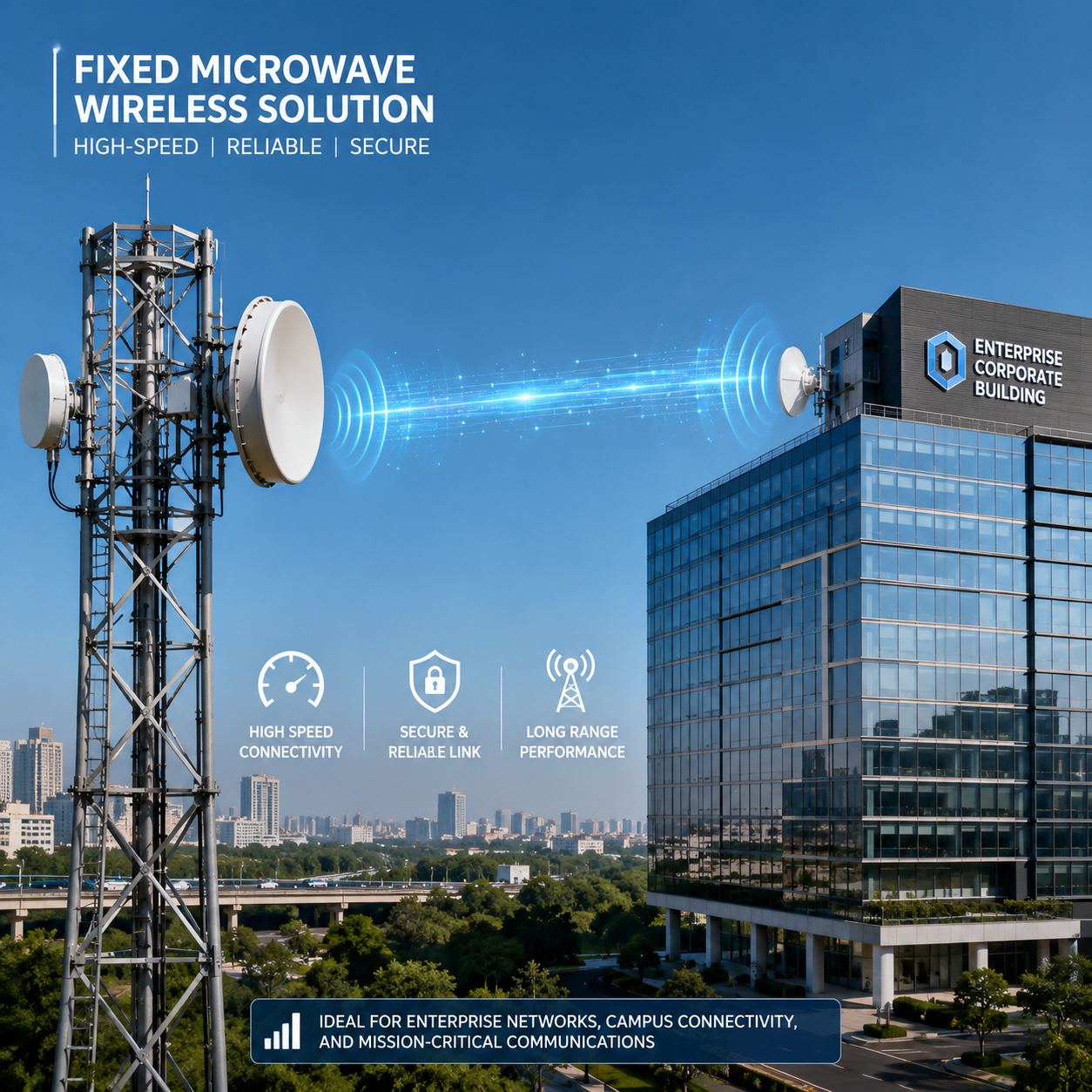
Fixed Wireless Access (FWA)—often referred to as Enterprise Point-to-Point (P2P) or Point-to-Multipoint (PtMP) Radio—delivers dedicated connectivity through high-frequency microwave or millimeter-wave radio signals. Transmission occurs between the ISP’s cell site tower and a high-gain directional transceiver mounted on the subscriber’s rooftop.
Enterprise-grade fixed wireless solutions operate on licensed or clean unlicensed radio frequencies (such as 5 GHz, 11 GHz, 18 GHz, or 23 GHz), bypassing the congestion issues common to consumer-grade wireless networks.
Key Advantages of Fixed Wireless Solutions
- Rapid Deployment Timelines: Because fixed wireless eliminates the need for civil excavation and municipal ducting rights, installation cycles are measured in days rather than months. Organizations requiring immediate enterprise connectivity can launch operations without waiting for physical cable paths.
- Physical Route Diversity: Fixed wireless infrastructure operates independently of ground-level civil works. It avoids physical fiber cuts caused by road construction, making it an ideal primary connection in growing commercial areas or a resilient redundant path for legacy systems.
- Hard-to-Reach Accessibility: For corporate locations situated away from established optical fiber backbones, fixed wireless bridges the gap seamlessly. It delivers high-throughput DIA across industrial zones, maritime ports, and suburban enterprise estates.
Strategic Implementation Challenges
- Line-of-Sight (LOS) Dependency: Fixed wireless requires an unobstructed optical line-of-sight between the subscriber’s rooftop antenna and the provider’s base station tower. Physical obstructions like new high-rise buildings or dense foliage require structural tower adjustments.
- Atmospheric Fading: Extreme weather events—such as torrential rainfall common in tropical regions—can cause brief rain fade on high-frequency microwave bands. Strategic engineering, robust link budgets, and adaptive modulation techniques mitigate this risk on enterprise-grade installations.
Head-to-Head Comparison: Fiber vs. Fixed Wireless DIA
Selecting the optimal connection medium requires evaluating key operational parameters against your organization’s business goals:
- Throughput Potential: Fiber provides virtually uncapped capacity, effortlessly scaling beyond 10 Gbps. Fixed wireless comfortably supports speeds up to 1 Gbps per link, meeting the needs of most small, medium, and large branch offices.
- Deployment Velocity: Fixed wireless installs rapidly within 3 to 7 business days. Fiber deployment typically ranges between 14 to 45 business days depending on distance and local civil permitting.
- Latency & Jitter: Fiber maintains single-digit millisecond latency (typically under 5 ms locally). Fixed wireless delivers sub-15 ms latency, which remains well within acceptable thresholds for real-time enterprise voice and cloud workflows.
- Uptime Resilience: Fiber is immune to atmospheric weather but vulnerable to physical ground construction cuts. Fixed wireless is immune to ground civil damage but requires strategic planning to counter severe weather fading.
- Capital Investment (CapEx): Fixed wireless requires lower initial deployment CapEx due to minimal civil engineering overhead. Fiber often carries higher setup costs for last-mile civil builds, though these balance out over long-term operations.
Designing a Hybrid Redundancy Strategy
Modern enterprises cannot afford single points of failure. Industry frameworks published by global networking leaders like Cisco recommend adopting multi-path WAN redundancy to achieve true zero-downtime continuity.
Rather than treating Fiber and Fixed Wireless as mutually exclusive choices, forward-thinking enterprise IT leaders deploy them in tandem within an active-active or active-passive High Availability (HA) network topology.
Combining a primary Fiber link with an air-path Fixed Wireless connection creates complete physical route diversity. If an underground optical cable is damaged by roadworks, the border gateway router seamlessly reroutes traffic over the radio link without dropping active voice calls or cloud sessions.
For remote or dispersed operations, integrating satellite technologies such as Starlink alongside terrestrial DIA offers reliable fallback options, keeping branch offices connected anywhere in the region.
TecPoint Global Solutions: Empowering Enterprise Connectivity Across Nigeria
Evaluating, deploying, and maintaining business internet requires a trusted partner with deep technical expertise and proven local infrastructure. TecPoint Global Solutions is an integrated Information and Communications Technology company and Internet Service Provider (ISP), delivering robust enterprise networking across Nigeria.
The TecPoint Enterprise Advantage
- Tailored Connectivity Architectures: We design custom Internet Leased Line solutions using dedicated fiber, enterprise fixed wireless, and satellite integrations built for your precise bandwidth and latency demands.
- End-to-End Enterprise Managed Services: Beyond last-mile connectivity, TecPoint delivers full Enterprise Managed Solutions—including National Leased Circuits (IP/MPLS), managed hosting, cloud interconnectivity, and VoIP integration.
- Integrated Cybersecurity Protection: Modern networks require robust security. TecPoint integrates advanced Network Security Solutions—featuring automated threat detection, data loss prevention (DLP), and network encryption—to defend your infrastructure against external vulnerabilities.
- Smart Enterprise Innovations: From scalable IoT frameworks to estate broadband and enterprise connectivity, our Smart Solutions drive digital transformation for businesses, commercial estates, and public sector organizations.
- Uncompromising Service Level Agreements: Backed by dedicated account engineers and 24/7 technical support, TecPoint ensures high uptime, continuous performance monitoring, and guaranteed MTTR to keep your enterprise running without interruption.
Whether your company is expanding its headquarters, migrating core systems to the cloud, or securing branch operations, TecPoint Global Solutions provides the reliable infrastructure your business demands.
Frequently Asked Questions (FAQs)
What is the main difference between Dedicated Internet Access (DIA) and Shared Business Broadband?
Dedicated Internet Access guarantees 100% reserved bandwidth exclusively for your business with a 1:1 contention ratio and symmetric upload/download speeds. Shared broadband distributes capacity among multiple businesses in your building or area, leading to unpredictable speed drops during peak commercial hours.
How does weather affect Fixed Wireless enterprise internet?
While consumer-grade wireless networks can suffer during storms, enterprise-grade Fixed Wireless operates on licensed high-frequency bands with robust link budgets. Proper antenna alignment and adaptive power management allow these links to maintain high reliability and performance, even during heavy rainfall.
Can an enterprise run both Fiber and Fixed Wireless at the same time?
Yes. Integrating Fiber as a primary link and Fixed Wireless as a secondary route is a standard enterprise networking best practice. This configuration provides true media and path diversity, protecting your organization from single points of failure like ground-level cable cuts.
What Service Level Agreements (SLAs) should businesses look for in a DIA contract?
Essential enterprise SLAs include guaranteed network uptime (typically 99.9% or higher), defined latency upper bounds, zero packet loss thresholds, and guaranteed Mean Time to Repair (MTTR) window commitments.
Is Fixed Wireless broadband as secure as Fiber Optic connectivity?
Yes. Enterprise Fixed Wireless networks employ advanced encryption protocols (such as AES-128/256) at the radio link layer. Combined with standard network security measures like firewalls and Virtual Private Networks (VPNs), Fixed Wireless links deliver robust security equivalent to physical wired connections.